


Hand operation and a defined tightening torque can both belong to the same M12 connection instruction. “Hand tight” describes how an operation is performed; it does not establish an interchangeable torque for every connector. Obtain the instruction for the exact mating pair, then separate the coupling collar from the cable gland, terminal fasteners and panel retaining nut.
“Tighten the connector” leaves too much open
A field-assembled M12 connection may contain several threaded parts within a few centimeters of one another. One joins the cable connector to the device. Another closes the rear cable entry. A panel-mounted counterpart may have its own retaining nut, while some termination designs contain small terminal screws. These parts perform different jobs and may require different tools, limits and assembly sequences.
A work instruction that gives one unqualified value invites the operator to apply it to the wrong part. A photograph with an arrow can be more useful than another line reading “securely tighten.” Identify the part that turns and the part that must be supported before adding any number to the instruction.
| Threaded part | Its task | Instruction must identify |
|---|---|---|
| Mating collar | Retains the connection to the selected counterpart. | Exact pair, engagement procedure, permitted tool and tightening criterion. |
| Rear gland or pressure nut | Acts on the specified cable-entry components. | Cable construction, assembled parts and the applicable closing instruction. |
| Panel retaining nut | Secures the device connector to the panel. | Mounting arrangement and how the body is supported. |
| Terminal screw, if present | Clamps the approved conductor preparation. | Termination design and its own assembly requirement. |
Why a manual collar can still have a limit
For one specific L-coded product range, ifm describes a collar suitable for manual tightening and also publishes a torque range with a requirement to observe the counterpart's maximum. That example shows why hand operation is not a universal specification. The product, counterpart and documented conditions still matter. Its numerical values and locking design do not apply to KMYD connectors.
Hands also work under different conditions. Gloves, restricted access, a smooth collar and the cable's tendency to turn can change how an operator approaches the task. These observations do not justify choosing a higher value. They are reasons to ask whether the specified method can actually be followed in the proposed enclosure, especially when several ports are close together.
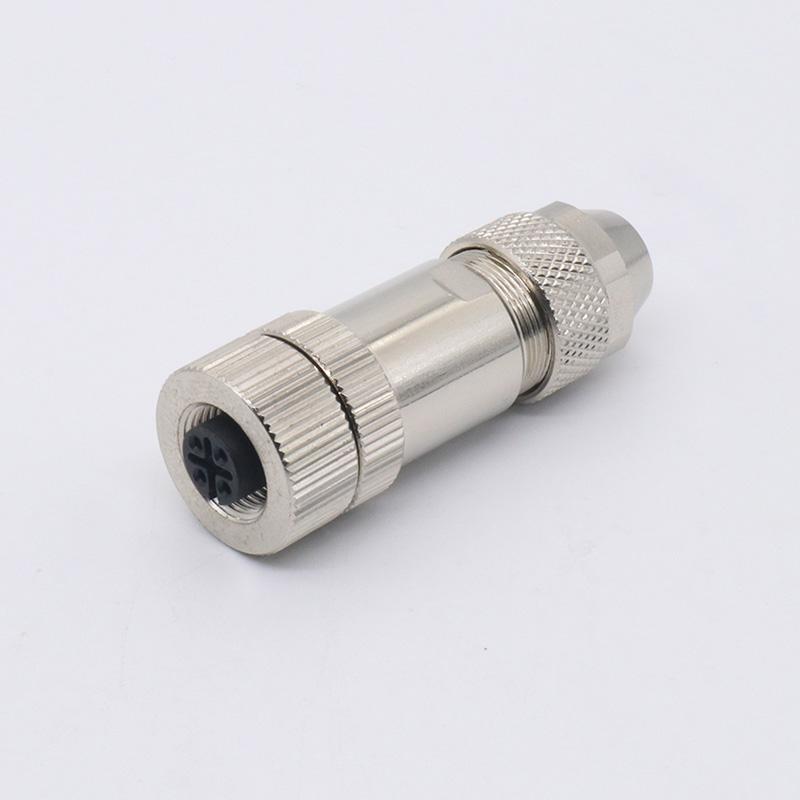
The KMYD M12 cable connector configuration is a product starting point. Send the selected counterpart and the requested termination variant with the inquiry, so the instruction can refer to a real assembly rather than an unspecified “M12.”
What to do when the drawing gives no torque
First establish whether another controlled document supplies the method: an installation sheet, counterpart manual or approved assembly instruction. A dimensioned sales drawing may not contain every assembly requirement. Ask for the document identifier and revision, plus an annotated view connecting each instruction to the relevant threaded part.
If the documents disagree, do not average the values or choose whichever seems easiest to achieve. Ask the supplier and equipment owner to resolve the exact combination. The answer may depend on the counterpart or mounting arrangement, and a number from a different catalog item is not evidence for the offered pair.
Do not turn an ordinary adjustable wrench, pliers or an extension into a substitute procedure. Likewise, adding adhesive or threadlocker changes the assembly conditions; it needs explicit approval for that connector and its materials. Repeatedly tightening a connection that moves in service can conceal a separate support, alignment or mounting problem.

A tightening card that an assembler can use
- Identify both mating parts and the document controlling the operation.
- Mark the collar or nut to be turned and the permitted support point.
- State the prescribed method, tool where applicable, and acceptance criterion.
- Keep rear-entry, terminal and panel-mount operations on separately named lines.
- Define what requires escalation: damaged threads, unexpected resistance or movement of a supposedly fixed body.
Verify the card on a representative isolated assembly with the actual access restrictions. If the specified tool cannot reach the collar, return that issue to the design review. An inaccessible operation has not been solved by omitting its requirement.
For the next RFQ, attach one marked-up photograph of the proposed M12 connector variant and ask for the controlling instruction for each marked operation. Leave unresolved values visibly open until the exact pair is confirmed.





 Tel: +8619924482730
 Email: info@kmydconnector.com
 MP/WhatsApp: +8619924482730
 Manufacturer Address:Baoan District, Shenzhen City, Guangdong Province,China