PCB-mounted M12 socket connectors are board-level circular Ethernet interfaces used to connect an industrial switch panel with its internal printed circuit board. Instead of using a separate internal cable harness, the connector is fixed to the enclosure panel while its rear contacts are soldered directly to the PCB. This structure gives the switch a compact, sealed, and mechanically stable front interface.
In industrial Ethernet switch design, this connector type is commonly used in rail transit, vehicle manufacturing, outdoor network nodes, factory automation, and other environments where vibration, dust, water spray, and repeated field maintenance must be considered. This article explains the technical role of PCB-mounted M12 sockets, the difference between D-coded and X-coded Ethernet versions, and the key design points for PCB layout, soldering, grounding, and selection.
Article directory
1. Definition and Design Scope
2. Structure and Interface Logic
3. D-Coded and X-Coded Selection
4. PCB Layout, Grounding, and Signal Path
5. Soldering and Assembly Control
6. Application Case: Train Ethernet Switch
7. Selection Checklist
8. FAQ
9. Conclusion
Definition and Design Scope
A PCB-mounted M12 socket is a through-panel M12 receptacle with rear contacts designed for direct soldering to a printed circuit board. It may use through-hole pins, SMT leads, or a mixed structure with support posts. On the equipment side, the connector presents a standard M12 circular interface for the field cable. On the internal side, it becomes part of the PCB signal path.
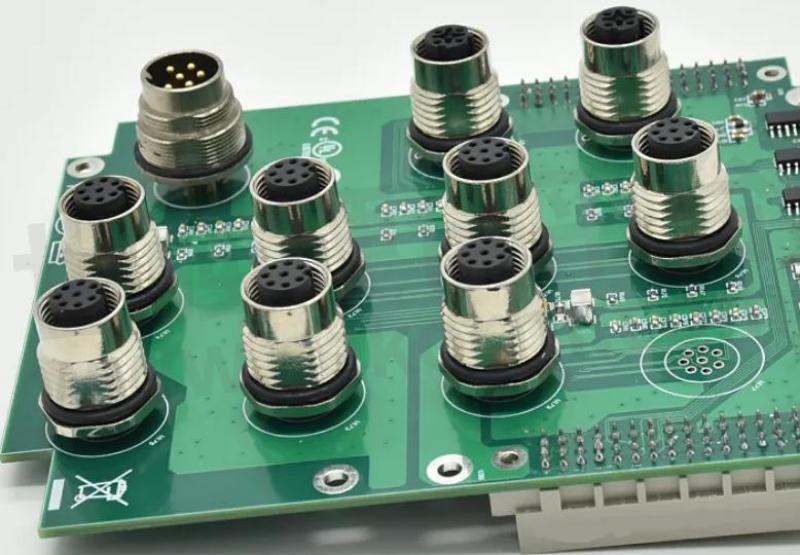
The design purpose is broader than signal transmission. The connector must provide mechanical fastening, environmental sealing, electrical continuity, and shielding support. When a field cable is inserted or tightened, the flange and panel should carry most of the mechanical force. The PCB solder joints should mainly provide electrical connection, not structural support.
| Term |
Meaning |
Buyer Relevance |
| PCB-mounted M12 socket |
M12 receptacle fixed to the panel and soldered to the PCB. |
Reduces wiring and saves enclosure space. |
| D-coded M12 |
Four-contact Ethernet M12 interface. |
Commonly used for 100 Mbps switch ports. |
| X-coded M12 |
Eight-contact Ethernet M12 interface. |
Used for Gigabit or high-bandwidth ports. |
| Flange sealing |
Sealing between connector flange and panel. |
Supports IP67 protection when correctly assembled. |
Definition note: IP protection, Ethernet speed, and long-term reliability are not determined by the connector alone. They also depend on mating cable quality, panel machining, gasket compression, PCB layout, soldering quality, and final assembly inspection.
Structure and Interface Logic
A typical PCB-mounted M12 socket includes a threaded front interface, a connector body, a mounting flange, sealing ring, positioning features, shield contacts, and rear PCB terminals. The connector is inserted through the equipment panel and locked by screws or a flange structure. The rear pins then align with the PCB footprint for soldering.
This creates a "panel-connector-PCB" structure. The panel defines the external port position. The connector provides mating geometry, sealing, shielding, and signal transition. The PCB provides differential-pair routing, Ethernet magnetics connection, grounding, and switching circuitry. If this structure is designed correctly, external cable stress is transferred to the panel instead of directly loading the solder joints.
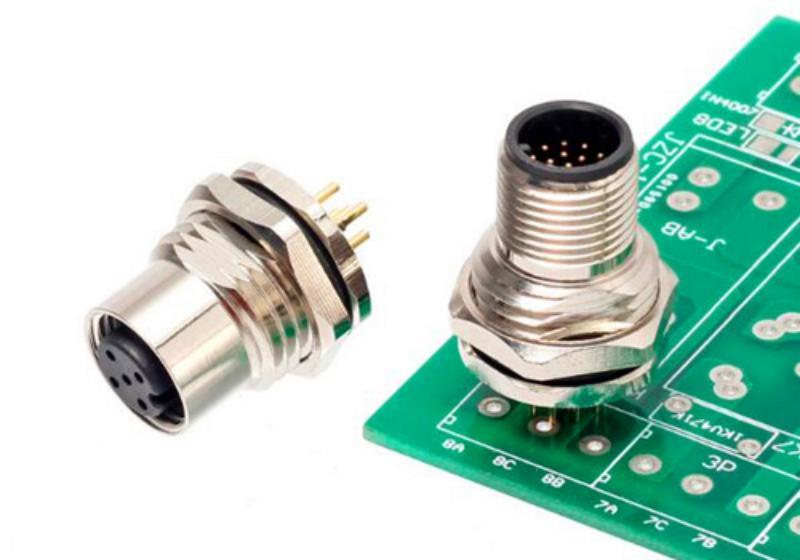
The flange is therefore not a secondary detail. It controls insertion force, mating torque, vibration resistance, and panel sealing. If the flange screws are loose, the connector may shift during cable movement. If the panel hole is too large, the gasket may not compress evenly. If the PCB-to-panel distance is wrong, the connector may preload the solder joints during assembly.
| Structure Element |
Function |
Risk if Poorly Designed |
| Flange and screws |
Transfer cable load to the panel. |
Connector movement or solder joint cracking. |
| O-ring or gasket |
Seal the panel opening. |
Water ingress during cleaning or outdoor use. |
| Positioning posts |
Align connector and PCB footprint. |
Pin-to-pad offset during soldering. |
| Shield contact |
Provide grounding and shielding path. |
Reduced EMC margin in noisy environments. |
D-Coded and X-Coded Selection
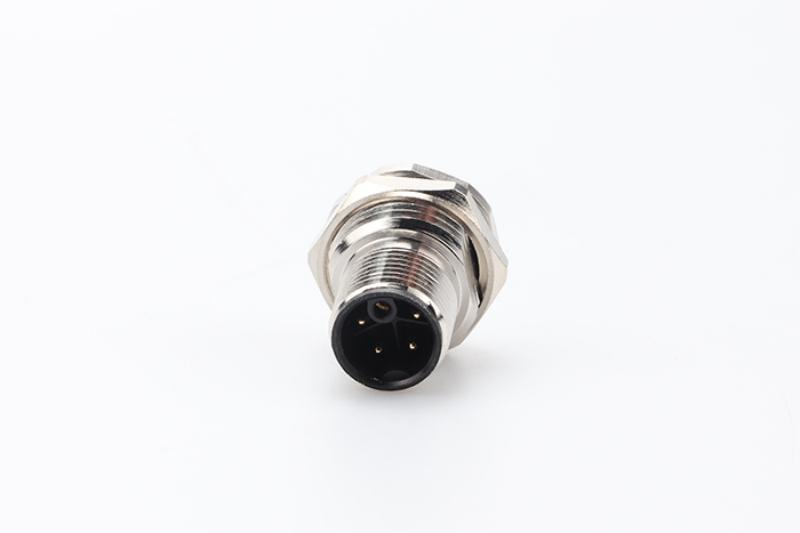
M12 Ethernet connectors use coding keys to prevent incorrect mating. For Ethernet switch panels, D-coded and X-coded versions are the main choices. D-coded M12 sockets are typically used for Fast Ethernet ports, while X-coded sockets are used for Gigabit Ethernet or higher-bandwidth applications. The selection should follow network architecture, not only component availability.
A D-coded socket normally uses four contacts and supports two differential pairs. It is suitable for many 100 Mbps industrial switch ports connected to PLCs, distributed I/O modules, sensors, train information devices, or general automation nodes. An X-coded socket uses eight contacts and supports four differential pairs, making it more suitable for uplinks, backbone ports, high-resolution cameras, and aggregation connections.
| Parameter |
D-Coded M12 |
X-Coded M12 |
Technical Meaning |
| Typical speed |
100 Mbps |
1 Gbps or higher depending on system design |
Match the switch port and cable category. |
| Contact count |
4 contacts |
8 contacts |
Defines available differential pairs. |
| Impedance target |
Commonly designed around 100 ohm differential impedance |
Commonly designed around 100 ohm differential impedance |
Must be coordinated with PCB routing. |
| Typical use |
Field access ports |
Uplink and backbone ports |
Different port roles may coexist on one panel. |
Method note: A switch panel may combine several D-coded ports for device access and one or two X-coded ports for uplink communication. In that case, the enclosure marking, PCB routing, test procedure, and service documentation should clearly distinguish the two coding types.
PCB Layout, Grounding, and Signal Path
The PCB footprint should support both solderability and mechanical alignment. For through-hole versions, plated holes must match pin diameter, plating thickness, and wave solder requirements. For SMT versions, pad geometry must support stable solder fillets without bridging. If the connector includes locating posts, the PCB should include matching positioning holes with suitable tolerance.
Positioning posts help the connector sit flat before soldering. If the holes are too loose, the connector may rotate slightly and cause pin-to-pad offset. If the holes are too tight, assembly pressure may deform the connector body or stress the board. The connector, PCB standoff, panel thickness, and flange position should be checked as one tolerance chain.
Grounding deserves separate attention. The shield contact of the M12 socket should connect to the PCB ground plane through a low-impedance path. A poor shield connection can degrade EMC performance, especially in rail transit or factory environments with motor drives and variable-frequency equipment. The ground plane should be continuous under the connector area, and the mounting screws should not be the only grounding path.
For differential pairs, the PCB routing should maintain consistent trace width and spacing to preserve the 100 ohm differential impedance target. Avoid vias near the connector footprint unless necessary, and keep the pair length matched to minimize skew. The Ethernet magnetics should be placed close to the connector to reduce the unshielded trace length between the socket and the transformer.
Soldering and Assembly Control
Soldering quality directly affects the electrical and mechanical performance of the PCB-mounted M12 socket. For through-hole versions, the solder fillet should fully wet the pin and the pad, with no voids or cold joints. For SMT versions, the solder paste volume and reflow profile must be validated for the specific connector footprint.
Assembly sequence matters. The connector should be fastened to the panel before or after soldering depending on the design. If the connector is soldered first and then mounted to the panel, the solder joints may be stressed during flange tightening. If the connector is mounted first, the PCB must be aligned carefully to avoid preloading the pins.
Inspection should include both visual checks and electrical tests. A continuity test verifies each pin is soldered. A differential impedance test on the connector-to-magnetics path can catch routing or footprint issues. For sealed panels, a leak test or IP rating verification should be performed after final assembly, not on the connector alone.
Application Case: Train Ethernet Switch
In a train Ethernet switch, the PCB-mounted M12 socket is often used for the external network ports. The switch panel may include several D-coded ports for connecting to passenger information displays, door control units, or onboard cameras, and one or two X-coded ports for the backbone network. The enclosure is typically sealed to IP67 to withstand cleaning and environmental exposure.
The design challenge is the combination of vibration, temperature cycling, and repeated cable mating. The flange must be torqued correctly to maintain sealing and mechanical stability. The PCB must be supported to prevent flexing during cable insertion. The shield connection must remain stable over the service life to preserve EMC performance in the traction environment.
For this type of application, the connector selection should include the mating cycle rating, the temperature range, and the vibration resistance. The panel cutout tolerance and the gasket compression should be verified with the actual enclosure. The PCB footprint should be validated with a prototype before production tooling is committed.
Selection Checklist
Before specifying a PCB-mounted M12 socket for an Ethernet switch panel, verify the following points with the connector supplier and your own design team:
- Confirm the coding type (D-coded or X-coded) matches the port speed and the mating cable connector.
- Verify the pin count and contact layout against the PCB footprint and the Ethernet magnetics pinout.
- Check the termination style (through-hole or SMT) against your soldering process and PCB thickness.
- Confirm the panel cutout diameter, panel thickness range, and flange mounting hole pattern.
- Verify the IP rating of the assembled panel, including the gasket compression and screw torque.
- Check the temperature range, mating cycle rating, and vibration resistance for the target environment.
- Validate the shield contact design and the PCB grounding path for EMC compliance.
- Request a sample for mechanical fit and soldering trials before production.
FAQ
Can a D-coded M12 socket be used for Gigabit Ethernet?
D-coded M12 connectors are typically designed for 100 Mbps Fast Ethernet. For Gigabit Ethernet, an X-coded M12 connector with eight contacts is the standard choice. Using a D-coded connector for Gigabit may not provide the required number of differential pairs or the impedance performance.
What is the difference between a PCB-mounted socket and a field-wireable socket?
A PCB-mounted socket has rear contacts designed for soldering to a printed circuit board. A field-wireable socket has screw terminals or crimp contacts for terminating a cable in the field. The PCB-mounted version is used inside equipment, while the field-wireable version is used on the cable end.
How is the IP rating of a PCB-mounted M12 socket achieved?
The IP rating depends on the complete assembly. The connector flange must be sealed to the panel with a gasket or O-ring, and the mating cable connector must be properly tightened. The IP rating is not guaranteed by the connector alone; it requires correct panel machining, gasket compression, and assembly torque.
Conclusion
PCB-mounted M12 socket connectors provide a compact and reliable Ethernet interface for industrial switch panels. The selection between D-coded and X-coded versions should follow the network speed and port role. The PCB layout, grounding, and soldering quality are as important as the connector itself for long-term performance.
For your next switch panel design, prepare the following information before contacting a supplier: the required port speed and coding type, the PCB thickness and soldering process, the panel cutout and mounting constraints, and the environmental requirements such as IP rating, temperature range, and vibration level. This will help the supplier recommend a suitable PCB-mounted M12 socket and validate the mechanical and electrical interface.







 Tel: +8619924482730
 Email: info@kmydconnector.com
 MP/WhatsApp: +8619924482730
 Manufacturer Address:Baoan District, Shenzhen City, Guangdong Province,China