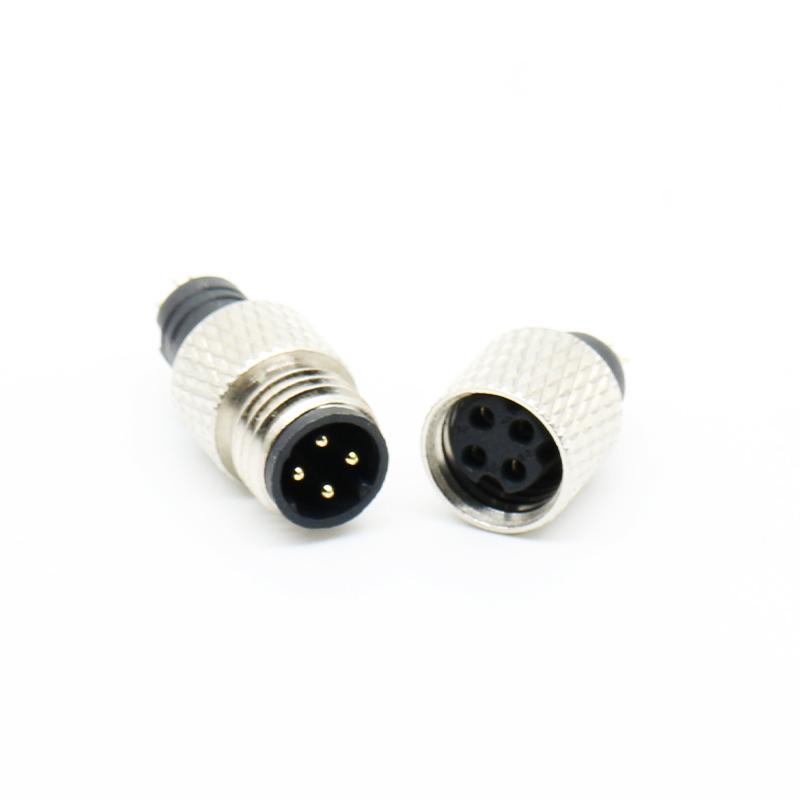
M8 screw crimp connectors are a common choice for sensor wiring, robotics, and compact control systems where space is limited but connection reliability still matters. The materials used in the contacts, insulator, housing, and sealing components determine how well the connector maintains electrical stability, resists mechanical stress, and survives the surrounding environment. This guide explains the typical materials found in M8 screw crimp connectors and how to match them to your application.
Contact Materials: The Foundation of Signal Transmission
Connector contacts carry the electrical signal and current. Their conductivity, elasticity, and corrosion resistance directly affect connection stability. For M8 screw crimp connectors, copper alloys are the standard base material for pins and sockets.
Brass is commonly used for male pins because it offers good electrical conductivity, easy machining, stable mechanical strength, and cost-effective manufacturing. Typical grades include CuZn39Pb3 and similar industrial brass alloys.
Phosphor bronze is often used for female socket contacts because of its superior elasticity and fatigue resistance. Its strong spring retention force improves mating reliability and durability after repeated insertion cycles. A typical grade is CuSn6 phosphor bronze.
Choosing the Right Contact Plating
Bare copper oxidizes easily, so contact surfaces are plated to improve corrosion resistance and electrical performance. The two most common plating options are gold and tin.
Gold plating provides the best long-term reliability for industrial connectors. It offers excellent corrosion resistance, stable low contact resistance, improved signal integrity, and longer mating cycle life. Thicker gold layers are recommended for harsh environments, high-frequency signals, and applications with frequent plugging cycles.
Tin plating is more economical and suitable for standard industrial environments. It provides good conductivity for low-frequency applications and is a common choice for general sensor wiring. However, tin plating typically provides shorter insertion life compared with gold plating.
Application Environment
Recommended Plating
Standard dry industrial environments
Tin-plated copper alloy
High humidity or corrosive environments
Gold plating ≥ 0.4 μm
High-speed signal transmission
Gold plating
Frequent mating cycles
Thick gold plating
Insulator Materials: Electrical Isolation and Heat Resistance
The insulator separates conductive contacts and prevents short circuits. Its material determines temperature resistance, dielectric strength, and flame-retardant performance.
PA66 (Nylon 66) is one of the most common insulating materials for M8 connectors. It offers high mechanical strength, good thermal resistance, cost-effective processing, and flame-retardant grades are available. The typical operating temperature range is -40°C to +85°C or higher depending on formulation. However, PA66 absorbs some moisture, which may slightly affect insulation resistance in high-humidity environments.
PBT (Polybutylene Terephthalate) offers better dimensional stability and lower moisture absorption than PA66. It provides excellent chemical resistance, stable electrical performance, and good long-term reliability. PBT is commonly used in higher-grade industrial connectors.
LCP (Liquid Crystal Polymer) is mainly used in high-performance or SMT-style M8 connectors. It offers extremely high heat resistance, is suitable for reflow soldering up to 260°C, provides excellent high-frequency performance, and has very low thermal expansion.
Housing and Coupling Nut Materials
The connector housing and locking nut must withstand repeated mating force, vibration, and environmental exposure.
Nickel-plated brass is the most common housing material for industrial M8 connectors. It provides high mechanical strength, good corrosion resistance, excellent EMC shielding, and precision machining capability. Metal housings also provide effective 360° electromagnetic shielding for industrial Ethernet and signal-sensitive applications.
Stainless steel housings are used in harsh industrial environments such as marine systems, outdoor equipment, food and beverage processing, and chemical plants. They offer superior corrosion resistance, high structural strength, and excellent durability. Common stainless steel grades include 303 and 304.
Reinforced plastic housings are used in some lightweight M8 connectors. They offer lower cost, a lightweight structure, and electrical insulation. However, plastic housings generally provide lower mechanical strength and reduced UV resistance compared with metal versions.
Sealing Materials and Cable Jacket Materials
Environmental sealing is critical for maintaining IP67 or IP68 protection ratings. The seal material must resist the fluids, temperatures, and chemicals present in the application.
FKM (Fluorocarbon Rubber) is one of the best sealing materials for industrial connectors. It offers excellent oil resistance, high chemical resistance, operating temperatures up to +200°C, and long-term durability. FKM seals are commonly used in automotive, machinery, and harsh industrial environments.
Silicone rubber offers excellent flexibility across a wide temperature range, typically -50°C to +180°C. It is suitable for general waterproof sealing but provides lower oil resistance than FKM.
NBR (Nitrile Rubber) provides good oil resistance at lower cost, with a typical temperature range of -30°C to +100°C. It is commonly used in standard industrial environments.
Cable jacket materials also play a role in overall system reliability. PVC is an economical solution for fixed installation wiring. PUR cable jackets are ideal for drag chain and robotic applications because of their excellent abrasion resistance, oil resistance, hydrolysis resistance, and flexibility. TPE materials are halogen-free and suitable for medical equipment and cleanroom applications.
Recommended Material Combinations by Application
The table below summarizes typical material combinations for common industrial applications. Use it as a starting point, then confirm the final selection against your specific operating conditions and the connector manufacturer's specification.
Application
Contact Material
Insulator
Housing
Seal
Cable Jacket
Standard industrial sensors
Tin-plated copper alloy
PA66
Nickel-plated brass or PA66
NBR
PVC
Machine tools and coolant environments
Gold-plated copper alloy
PBT
Nickel-plated brass
FKM
PUR
Outdoor and high-humidity applications
Gold-plated copper alloy
PBT or LCP
Stainless steel
FKM
PUR
High-temperature environments
Gold-plated copper alloy
LCP
Stainless steel or brass
FKM
Silicone or PTFE
High-speed data transmission
Gold-plated copper alloy
LCP
Shielded brass housing
FKM
PUR
Frequently Asked Questions
Frequently Asked Questions
What is the difference between brass and phosphor bronze contacts in M8 connectors?
Brass is typically used for male pins because it offers good conductivity, easy machining, and stable mechanical strength. Phosphor bronze is typically used for female sockets because its superior elasticity provides strong spring retention force and better durability after repeated mating cycles.
When should I choose gold-plated contacts over tin-plated contacts?
Choose gold plating for high humidity, corrosive environments, high-speed signal transmission, or applications with frequent mating cycles. Tin plating is more economical and suitable for standard dry industrial environments with lower mating frequency.
Is PA66 or PBT a better insulator material for M8 connectors?
PA66 is common and cost-effective, but it absorbs some moisture. PBT offers better dimensional stability and lower moisture absorption, making it a better choice for high-humidity environments or applications where stable insulation resistance is critical.
Why are metal housings preferred for M8 connectors in industrial Ethernet applications?
Nickel-plated brass housings provide effective 360° electromagnetic shielding, which helps protect signal integrity in electrically noisy environments. Stainless steel housings add superior corrosion resistance for harsh outdoor or chemical environments.
What seal material should I use for an M8 connector exposed to coolant or oil?
FKM (fluorocarbon rubber) is recommended for machine tool and coolant environments because it offers excellent oil and chemical resistance with operating temperatures up to +200°C. NBR provides good oil resistance at lower cost but has a lower temperature range.
Conclusion
Material selection for M8 screw crimp connectors is a balance between electrical performance, mechanical strength, environmental resistance, and cost. Gold-plated copper alloy contacts improve corrosion resistance and signal stability. PA66 and PBT insulators provide reliable electrical isolation, while metal housings enhance mechanical durability and EMI shielding. High-performance sealing materials such as FKM help connectors withstand oil, moisture, chemicals, and high temperatures.
Before finalizing your M8 connector choice, confirm the contact plating, insulator material, housing finish, and seal compound against your specific operating environment and mating frequency. If your application involves coolant, high humidity, or high-speed signals, verify the material combination with the connector manufacturer's specification. For a broader view of circular connector options, see our M8 M12 M16 circular connectors for industrial automation guide.





 Tel: +8619924482730
 Email: info@kmydconnector.com
 MP/WhatsApp: +8619924482730
 Manufacturer Address:Baoan District, Shenzhen City, Guangdong Province,China