


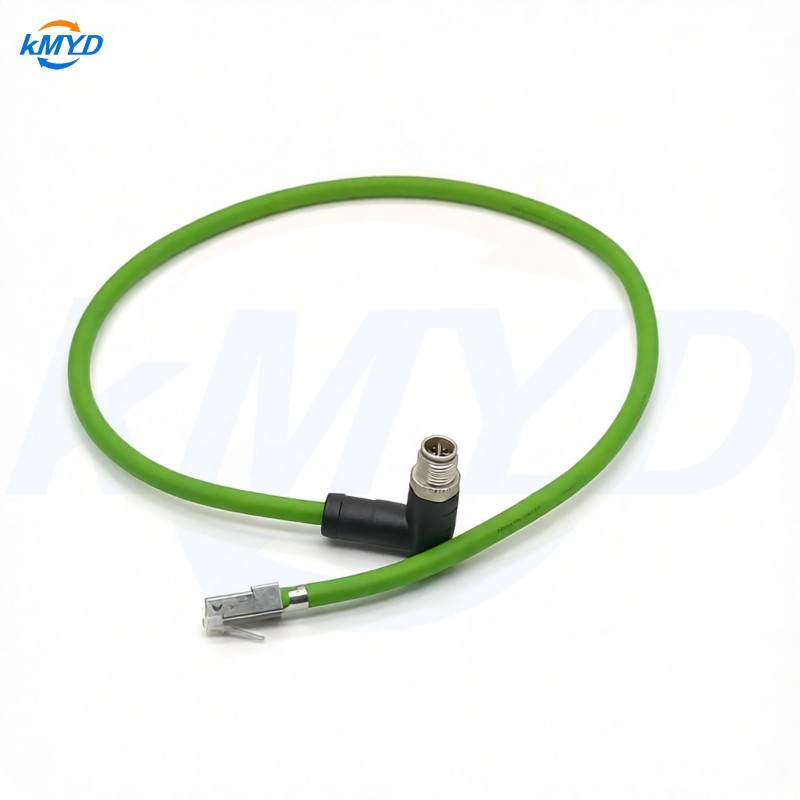
The ordered M12-to-RJ45 lead is one part of the Ethernet path. A channel budget must account for the complete passive connection between the relevant active ports, using the rules for the specified Ethernet application and cabling system. Include other cords, fixed cable, couplers and bulkhead connections. Do not subtract the custom lead from a familiar maximum distance until the system designer has confirmed that the limit and its construction assumptions apply to this installation.
Draw the path before adding the metres
A purchasing drawing may show a single cable from an enclosure wall to a machine. The network drawing may show more: a controller cord inside the enclosure, a panel connection, that external cable, another panel connection and a short cord to the receiving device. Ordering only the visible outside span does not describe the full channel.
Start at one active Ethernet port and follow every passive element to the next active port. Give the elements names that can be found on the installation drawing. A switch between two cable runs creates separate links; a passive adapter does not. If a device has several ports, identify the actual pair being connected so that an unrelated route does not enter the calculation.
Fluke Networks distinguishes a complete channel, including equipment and patch cords, from the fixed permanent link. That distinction is useful here: a report or drawing for the fixed cable cannot silently become evidence for every cord added later. Neither term is a universal distance rating for any cable with an M12 connector.
Keep two length records
- Assembly order
- The length and reference points used to manufacture this particular lead. Include the permitted variation and any breakout dimensions on its drawing.
- Network design
- The complete channel arrangement, the applicable application requirement and the allowance assigned to each passive section.
These records need to agree without becoming the same document. The assembly drawing controls the item delivered by the cable supplier. The channel schedule controls how that item fits the network. A drawing change that lengthens one lead can consume a channel allowance even when the supplier still builds exactly to the revised drawing.
Keep installation service loops in the route estimate. Cable placed in a loop still belongs to the electrical path. Conversely, a distance measured across the factory floor is not automatically the cable length: vertical drops, cabinet entries and routing restrictions can increase the installed route. Resolve that estimate before the cable length is frozen.
What can change an apparent allowance?
| Design input | What needs a decision |
|---|---|
| Ethernet application | Which physical layer, data requirement and applicable cabling rules define this link? |
| Cable construction | Do conductor construction and cord type match the assumptions behind the proposed allowance? |
| Connections | Which plugs, couplers and panel transitions are included, and does their arrangement meet the chosen rules? |
| Operating conditions | Does the design account for relevant temperature and installation conditions? |
| Future changes | What documented allowance remains for a replacement cord or revised route? |
Length is not the only variable. The construction of a flexible cord can differ from fixed installation cable, and the connection arrangement also matters. Do not treat a metre of every cable type as interchangeable merely because their jackets carry a similar category description. Obtain the applicable design rule or the equipment supplier's approved channel configuration.
Likewise, connector shape does not establish a cable's transmission performance. The M12 coding, the RJ45 end and the intended Ethernet service must all be appropriate, but those identities do not remove the need for a supported channel design. A physically compatible cord can still be the wrong choice for the specified channel arrangement.
Release the lead with a channel schedule
For a hypothetical cabinet-to-machine connection, list the internal cord, panel transition, external lead and receiving-side cord separately. Enter their proposed lengths and component references. Then ask the network owner to confirm the complete arrangement against the applicable application requirement. This is more useful than asking the assembly supplier whether an isolated cable is “short enough.”
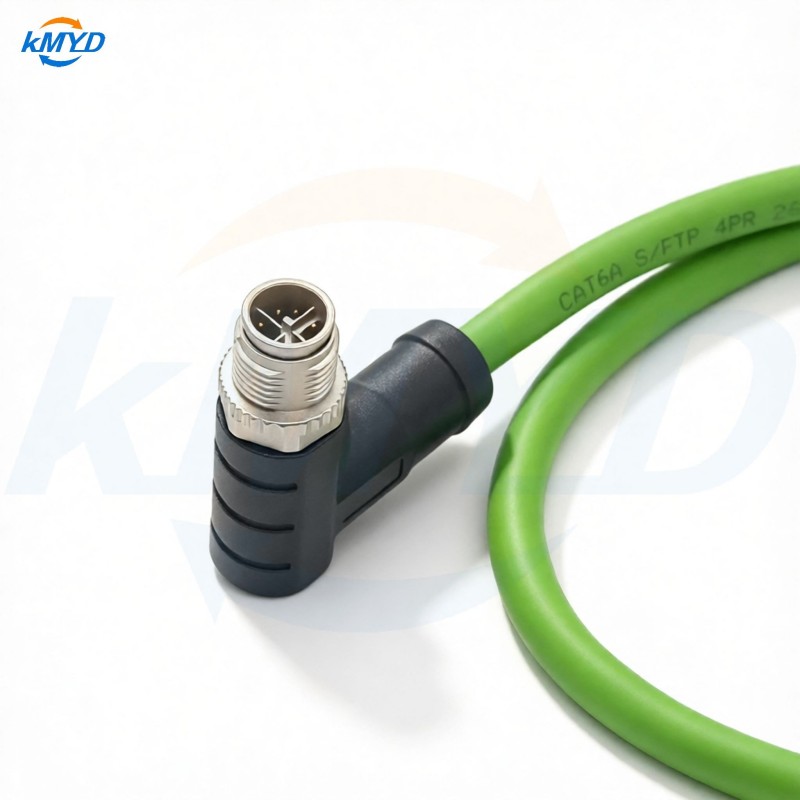
KMYD's X-coded M12-to-RJ45 cable listing provides a product route for discussing the custom lead. Send its proposed drawing together with the channel schedule, identify which section is being ordered, and request the exact cable construction and connector references. Keep any unresolved channel allowance open until the system designer supplies its basis.



 Tel: +8619924482730
 Email: info@kmydconnector.com
 MP/WhatsApp: +8619924482730
 Manufacturer Address:Baoan District, Shenzhen City, Guangdong Province,China